<?xml version="1.0" encoding="UTF-8"?>
<!--Generated by Squarespace Site Server v5.9.2 (http://www.squarespace.com/) on Thu, 11 Mar 2010 20:21:06 GMT--><rdf:RDF xmlns:rdf="http://www.w3.org/1999/02/22-rdf-syntax-ns#" xmlns:rss="http://purl.org/rss/1.0/" xmlns:dc="http://purl.org/dc/elements/1.1/" xmlns:sy="http://purl.org/rss/1.0/modules/syndication/" xmlns:admin="http://webns.net/mvcb/" xmlns:content="http://purl.org/rss/1.0/modules/content/" xmlns:cc="http://web.resource.org/cc/"><rss:channel rdf:about="http://www.johnfeeney.net/blog/"><rss:title>Blog</rss:title><rss:link>http://www.johnfeeney.net/blog/</rss:link><rss:description></rss:description><dc:language>en-US</dc:language><dc:date>2010-03-11T20:21:06Z</dc:date><admin:generatorAgent rdf:resource="http://www.squarespace.com/">Squarespace Site Server v5.9.2 (http://www.squarespace.com/)</admin:generatorAgent><rss:items><rdf:Seq><rdf:li rdf:resource="http://www.johnfeeney.net/blog/2009/10/14/broaching-the-subject-of-demon-agriculture.html"/><rdf:li rdf:resource="http://www.johnfeeney.net/blog/2009/8/26/a-deeper-understanding-of-carrying-capacity.html"/><rdf:li rdf:resource="http://www.johnfeeney.net/blog/2009/4/22/it-wasnt-long-ago.html"/><rdf:li rdf:resource="http://www.johnfeeney.net/blog/2009/2/3/bbc-green-room-article-population-the-elephant-in-the-room.html"/><rdf:li rdf:resource="http://www.johnfeeney.net/blog/2009/1/18/the-most-underreported-consequence-of-population-growth.html"/><rdf:li rdf:resource="http://www.johnfeeney.net/blog/2008/12/7/newspaper-proposes-supplement-on-population-in-conjunction-w.html"/><rdf:li rdf:resource="http://www.johnfeeney.net/blog/2008/11/30/gpso-in-science.html"/><rdf:li rdf:resource="http://www.johnfeeney.net/blog/2008/10/10/global-population-speak-out-make-the-pledge.html"/><rdf:li rdf:resource="http://www.johnfeeney.net/blog/2008/9/12/global-population-speak-out-gpso.html"/><rdf:li rdf:resource="http://www.johnfeeney.net/blog/2008/8/31/the-human-population-has-grown-at-the-direct-expense-of-non.html"/></rdf:Seq></rss:items></rss:channel><rss:item rdf:about="http://www.johnfeeney.net/blog/2009/10/14/broaching-the-subject-of-demon-agriculture.html"><rss:title>Broaching the subject of demon agriculture</rss:title><rss:link>http://www.johnfeeney.net/blog/2009/10/14/broaching-the-subject-of-demon-agriculture.html</rss:link><dc:creator>John Feeney</dc:creator><dc:date>2009-10-14T22:15:40Z</dc:date><dc:subject>Agriculture Carrying capacity Civilization Population Rewilding Sixth Extinction</dc:subject><content:encoded><![CDATA[<p>An recent <a href="http://www.montrealgazette.com/opinion/Fertility+rates+drop+when+children+better/2056925/story.html">opinion piece</a> by anthropologist Donald Attwood in the Montreal Gazette created a good opportunity for a letter to the editor. I tried an understated approach, nudging a general readership to begin thinking about the corner we've painted ourselves into via  agriculture. It's what John Zerzan calls the <a href="http://www.awok.org/agriculture/">"demon engine of civilization."</a> Here's the letter (or read it <a href="http://www.montrealgazette.com/opinion/letters/Problems+began+with+agriculture/2093095/story.html">at the Gazette</a>):</p>
<blockquote>I share Donald Attwood's concern that children not go hungry. But as an environmental writer, I suggest his argument ignores a fundamental ecological principle: Population follows food supply. This is the base mechanism that kept human population size within carrying capacity for most of our history. It works well for all species on Earth, regulating fertility rates with no particular suffering.<br /><br />Ten thousand years ago, with the adoption of agriculture, we began to circumvent this natural process, slowly clearing land and tearing down the web of life (spurring the sixth mass-extinction event in Earth's history) to produce an ever-increasing global food supply. More recently we added fossil fuels to the equation, inflating the food supply even more. The result of these developments has been an explosion of human numbers of over 130,000 per cent.<br /><br />Other layers of influences do come into play as well, which is why many countries now have lower fertility rates. Social factors such as the education of women and the widespread availability of family planning options do appear to correlate with reductions in fertility rates. If we want to encourage lower fertility rates in sub-Saharan Africa, we should focus on those factors. This does not mean forgoing food aid. But we must begin to confront how we have short-circuited nature's normal mechanism for population regulation. Short term, the best suggestion seems to be one of tying food aid to increases in family-planning options (and media strategies encouraging their use) as well as increased education for women.<br /><br />Slightly longer term, we need to take a hard look at the problem of large-scale agriculture. It won't be easy; agriculture is the very foundation of civilization. But it has pushed us into gross overshoot of human carrying capacity with the threat of a massive population crash looming in the future.<br /><br />John C. Feeney<br /><br />Boulder, Colo.<br /></blockquote>
<p>It is, in many ways, <em>the</em> key topic facing humanity. I doubt mainstream society will voluntarily confront it in any serious way, but there's value in people coming to consider the core problems which make civilization an unsustainable trap. It's essential knowledge for those interested in <a href="http://tobyspeople.com/ideas/a-rewilding-renaissance">rewilding</a>.</p>]]></content:encoded></rss:item><rss:item rdf:about="http://www.johnfeeney.net/blog/2009/8/26/a-deeper-understanding-of-carrying-capacity.html"><rss:title>A deeper understanding of carrying capacity</rss:title><rss:link>http://www.johnfeeney.net/blog/2009/8/26/a-deeper-understanding-of-carrying-capacity.html</rss:link><dc:creator>John Feeney</dc:creator><dc:date>2009-08-27T05:17:55Z</dc:date><dc:subject>Agriculture Carrying capacity Civilization Population Rewilding Sixth Extinction</dc:subject><content:encoded><![CDATA[<p>Lately it appears more people are beginning to consider the problem of human population size as it relates to carrying capacity. Nevertheless, misunderstanding abounds. Since my focus is elsewhere right now, and I have no plan to write on this topic for publication in the near future, I offer a few thoughts here. This is merely a quick sketch with much detail, some points of logic, and additional convincing evidence omitted. I may flesh it out sometime in the future.</p>
<p>_______</p>
<p>Have we exceeded the earth's carrying capacity for humans? Many observers conclude there is no way to answer the question with any confidence. I believe their view stems from an assumption which fails to hold up to analysis. It is the common notion that, through human ingenuity, we've been able, through the course of history, to <em>increase</em> carrying capacity. <br /><br />This idea is based on the correct observation that the advent of agriculture and our later use of fossil fuels were central among those developments which allowed us to grow the human population as enormously as we have. It does not follow, however, that these developments increased carrying capacity. <br /><br />The error here is in failing to account properly for overshoot. Animal populations regularly overshoot or grow <em>beyond</em> carrying capacity. It is <a href="http://growthmadness.org/2007/10/31/six-steps-to-getting-the-global-ecological-crisis/">simple enough to demonstrate</a> this has happened with the human population. Agriculture and fossil fuels have not increased carrying capacity; they have merely led to our overshooting it, supported by what William Catton calls "phantom carrying capacity." It is not carrying capacity at all, and is only temporary. [1] <br /><br />This is especially easy to see with regard to oil depletion. Oil is a finite resource. Relying on it, therefore, to support global food production can only be temporary. <br /><br />But here are two less widely recognized observations which also support my point: First, agriculture as we know it has always been unsustainable. It has brought with it  soil erosion and an inevitable depletion of soil nutrients at rates far faster than their natural rates of renewal. This is comparable to our depletion of finite resources such as oil. It may have taken ten thousand years for us to see this, but that is barely an eye blink in human history. [2] <br /><br />Second, consider that none of the processes which have allowed our numbers to explode has come without cost to the web of life. We know well enough about the environmental impacts of extracting and burning fossil fuels. Less discussed is the cost of agriculture to other species. Cultivation agriculture means the elimination of all life from a piece of land, turning it then exclusively to human use. [3] [4] Multiply this by <a href="http://books.google.com/books?id=cGgeojAN8JcC&amp;pg=PA311&amp;lpg=PA311&amp;dq=agriculture+%22Billion+acres+OR+hectares%22+worldwide&amp;source=bl&amp;ots=9PPeIIeUCa&amp;sig=JWvnCTFuA5ICdJDmr7kxwpOVTvk&amp;hl=en&amp;ei=fguWSvLOO4-AsgO59qWRDA&amp;sa=X&amp;oi=book_result&amp;ct=result&amp;resnum=29#v=onepage&amp;q=agriculture%20%22Billion%20acres%20OR%20hectares%22%20worldwide&amp;f=false">over a billion</a> hectares and we see clearly how agriculture has been the primary driver of the <a href="http://www.actionbioscience.org/newfrontiers/eldredge2.html">Sixth Mass Extinction</a> of species in Earth's history, the direct destruction of Earth's life support systems.</p>
<p>Not only have we not increased carrying capacity, we have <em>decreased</em> it. It's simple ecology. We depend on the web of life for our own survival. When a species consumes resources faster than they are renewed, degrading the habitat on which it depends, it <a href="http://growthmadness.org/2007/10/31/six-steps-to-getting-the-global-ecological-crisis/">erodes carrying capacity</a>.</p>
<p>The damage we have done to the biosphere and the web of life has temporarily allowed us to grow our numbers but has reduced carrying capacity. This may be hard to believe when we consider that for nearly all of human history, prior to exploding into the billions, our numbers never exceeded more than a few million. It underscores the shocking degree by which we've overshot carrying capacity.</p>
<p>No, there is no evidence we have increased carrying capacity. Rather, basic principles of ecology reveal we have managed only to overshoot it by an incredible margin.<br /> <br /> _______<br /> <br /> For some underlying fundamentals of carrying capacity please see the article <a href="http://growthmadness.org/2007/10/31/six-steps-to-getting-the-global-ecological-crisis/">Six Steps to "Getting" the Global Ecological Crisis</a>.<br /> <br /> [1] For much more see Catton's classic text, <a href="http://www.amazon.com/Overshoot-Ecological-Basis-Revolutionary-Change/dp/0252009886/ref=pd_bbs_sr_1?ie=UTF8&amp;s=books&amp;qid=1195605867&amp;sr=1-1">Overshoot</a>. <br /><br />[2] For more detail see <a href="http://www.theoildrum.com/node/4628">Agriculture: Unsustainable Resource Depletion Began 10,000 Years Ago</a> by soil scientist Peter Salonius.</p>
<p>[3] For an illuminating description of this process see Lierre Kieth's <a href="http://www.amazon.com/Vegetarian-Myth-Food-Justice-Sustainability/dp/1604860804/ref=sr_1_1?ie=UTF8&amp;s=books&amp;qid=1251350659&amp;sr=8-1">The Vegetarian Myth</a>.</p>
<p>[4] Even a major improvement such as <a href="http://www.energybulletin.net/node/19334">permaculture</a> may suffer from a similar problem of turning the land excessively to human consumption. As I understand it, however, it is structured to be practiced on a scale small enough -- and with constraints against large populations --&nbsp; that it might prove  sustainable under conditions of a much smaller human population. This is not to suggest it as an "alternative" to agricululture, without which humans did <a href="http://www.primitivism.com/original-affluent.htm">quite well</a> for most of our history.<br /><br /></p>]]></content:encoded></rss:item><rss:item rdf:about="http://www.johnfeeney.net/blog/2009/4/22/it-wasnt-long-ago.html"><rss:title>It wasn't long ago</rss:title><rss:link>http://www.johnfeeney.net/blog/2009/4/22/it-wasnt-long-ago.html</rss:link><dc:creator>John Feeney</dc:creator><dc:date>2009-04-22T21:54:25Z</dc:date><dc:subject>Agriculture Civilization Population Rewilding</dc:subject><content:encoded><![CDATA[<p><em>Once I moved about like the wind. Now I surrender to you and that is all.</em> -- Geronimo</p>
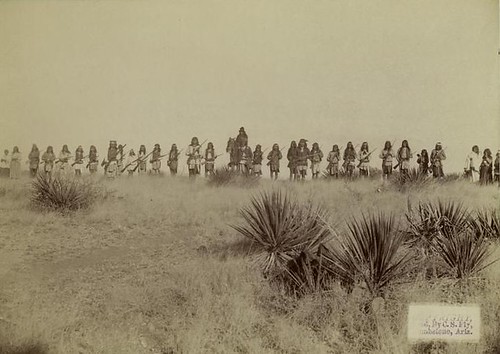
<p><a title="geronimo and band on ridge"><img src="http://farm4.static.flickr.com/3562/3466813383_bf3d29f6a5.jpg" alt="geronimo and band on ridge" width="500" height="354" /></a></p>
<p>This is a photo (slightly cropped) of the last band of aboriginal people in North America to fight and resist the takeover of their landbase by the United States government. Numbering about 39, including women and children, this band of Apaches including Naiche, son of Cochise (on horseback) and Geronimo (standing in front of Naiche), evaded capture by a quarter of the US army and&nbsp; three thousand Mexican troops, finally turning themselves in, ending a key chapter in human history.</p>
<p>The ending of a tribal, non-agricultural way of life among the aboriginal peoples of North America happened in about the same way it has happened worldwide. Central among proximate causes has been the growth of the population of those of us in civilization. The root cause has been civilization itself.</p>
<p>The people in the photo are standing on a spot in what is today southern Arizona. Twenty years after the photo was taken, my grandmother took a teaching job in a small town not far from that spot. She lived into the late 1980s. Indeed, it wasn't long ago that people still lived freely, as had their ancestors, apart from agriculture-based industrial civilization, right here where we in the United States live today. [1] [2]</p>
<p>Likewise, relative to the whole of human history, it has been only in the last instant that not everyone has lived in small bands, foraging and hunting for food, attuned to rather than trying to separate themselves from nature. [3]</p>
<p>Today as we puzzle over where we went wrong ecologically and socially, and scramble to find some way to fix things, we forget that for 3 million years we had many variations on a basic system which worked, made for fulfilling lives, and was sustainable.</p>
<p>I expect to focus much more on this topic in future writing.</p>
<p>For some insightful references see the section on <a href="http://www.johnfeeney.net/core-ecological-issues/">core ecological issues</a> and the relevant books in the <a href="http://www.johnfeeney.net/recommended-books/">book section</a>. For an engaging source on the events surrounding the photo above, try David Roberts' <em><a href="http://www.amazon.com/Once-They-Moved-Like-Wind/dp/0671885561/ref=sr_1_1?ie=UTF8&amp;s=books&amp;qid=1240616640&amp;sr=1-1">Once They Moved Like the Wind</a></em>.</p>
<p>_______</p>
<p>[1] During much of their history, and certainly at the time of the photo, the Apache were not strictly hunter-gatherers. Owing to their roots, however, their surrender is an appropriate symbol for the loss of a way of life based not on agriculture, attuned to the natural world.</p>
<p>[2] While Geronimo's surrender marked the official end of the "Apache wars," reports suggest remnant bands of Apaches continued to live freely in the mountains of Mexico for years afterward.</p>
<p>[3] The period since the dawn of agriculture 10 thousand years ago to the present represents about one third of one percent of human history.</p>
<p>&nbsp;</p>]]></content:encoded></rss:item><rss:item rdf:about="http://www.johnfeeney.net/blog/2009/2/3/bbc-green-room-article-population-the-elephant-in-the-room.html"><rss:title>BBC Green Room article - Population: the elephant in the room</rss:title><rss:link>http://www.johnfeeney.net/blog/2009/2/3/bbc-green-room-article-population-the-elephant-in-the-room.html</rss:link><dc:creator>John Feeney</dc:creator><dc:date>2009-02-03T04:49:53Z</dc:date><dc:subject>Carrying capacity Population</dc:subject><content:encoded><![CDATA[<p><a href="http://news.bbc.co.uk/2/hi/science/nature/7865332.stm">This article was published</a> today at the Green Room. It examines the taboo currently suppressing open, public discussion of human overpopulation. It introduces the <a href="http://gpso.wordpress.com/">Global Population Speak Out</a>, a project designed to weaken the taboo.</p>
<p>One point I'd like to have made more strongly is that the taboo is especially visible in the failure of major environmental organizations to speak up about overpopulation. They need to be pushed until they do. Otherwise, they have no chance of playing a major role in solving the global ecological crisis.</p>]]></content:encoded></rss:item><rss:item rdf:about="http://www.johnfeeney.net/blog/2009/1/18/the-most-underreported-consequence-of-population-growth.html"><rss:title>The most underreported consequence of population growth?</rss:title><rss:link>http://www.johnfeeney.net/blog/2009/1/18/the-most-underreported-consequence-of-population-growth.html</rss:link><dc:creator>John Feeney</dc:creator><dc:date>2009-01-19T01:04:58Z</dc:date><dc:subject>Population Rewilding</dc:subject><content:encoded><![CDATA[<p>From the <a href="http://gpso.wordpress.com/blog/">GPSO blog</a>:</p>
<p>A seldom discussed, tragic consequence of human population growth is the loss of tribal cultures and peoples. It is the loss, as well, of ways of life which persisted for nearly all of human history until our population exploded in the last fraction of one percent of our time on Earth.</p>
<p>If anyone participating in GPSO wants to to speak out on one of the most underreported consequences of the growth of the human population, this would be a good choice.</p>
<p>An excellent source of information is the site of <a href="http://www.survival-international.org/home">Survival International</a>.</p>
<p>***********</p>
<p>I would add that Survival International seems to say little about the obvious, fundamental link between population growth and the loss of tribal peoples. I suspect it's a sign of how powerful the taboo against mention of overpopulation has been. I hope they'll feel freer in the future to talk about it. It's hard to imagine any hope for tribal cultures if the rest of the world's population grows much bigger.</p>
<p>&nbsp;</p>]]></content:encoded></rss:item><rss:item rdf:about="http://www.johnfeeney.net/blog/2008/12/7/newspaper-proposes-supplement-on-population-in-conjunction-w.html"><rss:title>Newspaper proposes supplement on population in conjunction with GPSO</rss:title><rss:link>http://www.johnfeeney.net/blog/2008/12/7/newspaper-proposes-supplement-on-population-in-conjunction-w.html</rss:link><dc:creator>John Feeney</dc:creator><dc:date>2008-12-07T20:37:59Z</dc:date><dc:subject>Population</dc:subject><content:encoded><![CDATA[<p>Here's the word from George Plumb, President of <a href="http://www.vspop.org/">Vermonters for a Sustainable Population</a>:</p>
<blockquote>In conjunction with the the <a href="http://gpso.wordpress.com/">GPSO</a> the weekly community newspaper of the state capitol of Montpelier, Vermont has proposed doing an eight page supplement on population. I think this will be pretty ground breaking. How many newspapers in the country have devoted a supplement to population? The only problem is Vermonters for a Sustainable Population, of which I am the president, needs to come up with $3,000 to help pay for the xtra costs. Unfortunately we have no major donors cpable of this kind of financial support in our thrity member organization. If anyone knows of a potential source I would really appreciate your ideas.</blockquote>
<p>That would be a first wouldn't it? So if you know any source to help with funding please let me know and I'll forward your message to George, or <a href="http://www.vspop.org/htm/officers.htm">go here</a> to contact George directly.</p>]]></content:encoded></rss:item><rss:item rdf:about="http://www.johnfeeney.net/blog/2008/11/30/gpso-in-science.html"><rss:title>GPSO in Science</rss:title><rss:link>http://www.johnfeeney.net/blog/2008/11/30/gpso-in-science.html</rss:link><dc:creator>John Feeney</dc:creator><dc:date>2008-11-30T19:21:36Z</dc:date><dc:subject>Population</dc:subject><content:encoded><![CDATA[<p>A recent issue of <em>Science</em> contains a short piece on <a href="http://gpso.wordpress.com/">GPSO</a>. If you're registered there, you'll find it <a href="http://sciencemag.org/content/vol322/issue5902/r-samples.dtl#322/5902/655d">here</a>. It's in the "Random Samples" section of the October 31 issue, Volume 322, Issue 5902.  From the piece:</p>
<blockquote>At a time when some developed nations are paying citizens to bolster flagging birth-rates (Science, 30 June 2006, p. 1894), a grass-roots group of scientists and environmentalists is calling for a new push to limit human numbers.</blockquote>
<blockquote>Overpopulation is threatening life as we know it on the planet, say members of a movement called Global Population Speak Out (<a href="http://gpso.wordpress.com/">http://gpso.wordpress.com/</a>), which aims to persuade at least 50 &ldquo;respected voices&rdquo; to &ldquo;speak out in some way&rdquo; about the problem for a month next year.</blockquote>
<p>GPSO is bringing scientific voices worldwide to bear on the population issue. It's great to have the opportunity to alert a large portion of the scientific community to what we're doing.</p>]]></content:encoded></rss:item><rss:item rdf:about="http://www.johnfeeney.net/blog/2008/10/10/global-population-speak-out-make-the-pledge.html"><rss:title>Global Population Speak Out: Make the pledge!</rss:title><rss:link>http://www.johnfeeney.net/blog/2008/10/10/global-population-speak-out-make-the-pledge.html</rss:link><dc:creator>John Feeney</dc:creator><dc:date>2008-10-10T23:32:25Z</dc:date><dc:subject>Population</dc:subject><content:encoded><![CDATA[<p>The <a href="http://gpso.wordpress.com/">GPSO</a> <a href="http://gpso.wordpress.com/gpso-letter/">letter</a> (see the prior entry <a href="http://www.johnfeeney.net/blog/2008/9/12/global-population-speak-out-gpso.html">here</a>) is now going out and we are receiving pledges. Note that you do not have to receive the GPSO letter to participate. Please <a href="http://gpso.wordpress.com/gpso-letter/you-too-can-participate/">go here</a>, read the directions, and send in your pledge! Chances are you might fit in some way into one of the official categories of invitees. But that is not a necessity; we cannot cover every reasonable category. We will make every effort to document whatever action you take to speak out. So just pledge!</p>
<p>Be a part of this historic event. Send your pledge to GlobalPopulationSpeakOut [at] gmail [dot] com</p>]]></content:encoded></rss:item><rss:item rdf:about="http://www.johnfeeney.net/blog/2008/9/12/global-population-speak-out-gpso.html"><rss:title>Global Population Speak Out (GPSO)</rss:title><rss:link>http://www.johnfeeney.net/blog/2008/9/12/global-population-speak-out-gpso.html</rss:link><dc:creator>John Feeney</dc:creator><dc:date>2008-09-12T02:25:23Z</dc:date><dc:subject>Population</dc:subject><content:encoded><![CDATA[<p><a href="http://gpso.wordpress.com/">(Go straight to the GPSO website)</a></p>
<p>I write to raise awareness of certain fundamental but underreported and generally misunderstood ecological issues, particularly the problem of the size and growth of the human population. Sometimes something other than writing may hold more potential in that regard.</p>
<p>Not long ago I came up with an idea for a small project aimed at bringing <em>new or returning voices </em>to the public discussion of population issues. That project is now a reality. It's called the Global Population Speak Out (GPSO) and is <a href="http://gpso.wordpress.com/">documented on its own website.</a></p>
<p>It's an effort to weaken the taboo against speaking out on population. It came from a simple idea: What would happen if a lot of new, qualified voices were to speak out on population <em>all at once</em>? Wouldn't that go a long way toward breaking down the taboo?</p>
<p>GPSO hinges on a letter (actually an email) we will send to a large number of scientists, environmental writers, executives of environmental NGOs, and other prominent people. Only a few are widely known for public statements on the population issue. We invite them to speak out on it during February in any way they choose.&nbsp; A key is that they can be <em>sure</em> they will have plenty of good company in speaking out; for only if we get at least 50 pledges to speak out will we ask participants to honor their pledges.</p>
<p>Note that <a href="http://gpso.wordpress.com/gpso-letter/you-too-can-participate/">you too can participate</a>!</p>
<p>Our hope is that by concentrating these messages about population into one month and seeing to it that most come from voices not already widely associated with the issue, we'll grow the number of people who speak publicly on the topic, raise the prominence of the issue, and make it a little easier for others to speak out in the future.</p>
<p>I'm pleased to report that some highly respected scientists, writers, environmental activists, and others have lent their names to the project as signers of the <a href="http://gpso.wordpress.com/gpso-letter/">GPSO letter</a>. Their willingness to sign on speaks to the urgency of the population issue and gives the project a real chance to succeed. <br /></p>
<p>Let's see how this thing goes!</p>]]></content:encoded></rss:item><rss:item rdf:about="http://www.johnfeeney.net/blog/2008/8/31/the-human-population-has-grown-at-the-direct-expense-of-non.html"><rss:title>The human population has grown at the direct expense of non-human populations</rss:title><rss:link>http://www.johnfeeney.net/blog/2008/8/31/the-human-population-has-grown-at-the-direct-expense-of-non.html</rss:link><dc:creator>John Feeney</dc:creator><dc:date>2008-08-31T18:32:40Z</dc:date><dc:subject>Population Rewilding Sixth Extinction</dc:subject><content:encoded><![CDATA[<p>Relevant to an article on which I'm slowly working, an important new study looking at human population growth and the Quaternary Megafauna Extinction shows our population has grown at the <i>direct </i>expense of other species. Here's marine scientist Emmett Duffy's summary and discussion of the study:</p><a href="http://naturalpatriot.org/2008/08/29/biodiversity-and-the-limits-to-growth/">http://naturalpatriot.org/2008/08/29/biodiversity-and-the-limits-to-growth/</a><p><br>Here's the study:<br></p><a href="http://www.pnas.org/content/105/suppl.1/11543.abstract">http://www.pnas.org/content/105/suppl.1/11543.abstract</a><br><br><p>We must be cautious though in interpreting these data. They do not mean pre-agricultural people were causing <span>extinctions</span> at rates resembling those we're seeing today. In fact, the evidence is clear that for nearly all of human history prior to agriculture, hunting-gathering ways of living came much, much closer than today's society to true sustainability -- in part because population sizes were so much smaller. (Evidence suggests, in fact, that many hunting-gathering societies made
efforts to hold their populations to within ecological limits. [1]) As mentioned in the article, species extinction rates were modest until not long before the advent of agriculture when the growth of the human population began to accelerate. </p>]]></content:encoded></rss:item></rdf:RDF>